


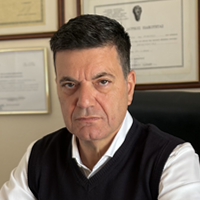
Profile
Director, Interventional Cardiologist, Metropolitan Hospital
Director, Structural Heart Valve and Coronary Interventions Team
Consultant Interventional Cardiologist, Wexham Park Hospital, London, UK
Education & academic titles
Medical School
Studied at the School of Medicine of the National and Kapodistrian University of Athens, where he obtained his medical degree (1985-1991)
Specialization in Cardiology
Completed his specialty training in Cardiology at the Department of Cardiology of Tzaneio General Hospital of Piraeus (1997-2001)
Training in the USA
During the final year of his specialty training, he received advanced training in Interventional Cardiology and Modern Medical Research at Saint Vincent Medical Center in New York (2000-2001)
Specialized Training in Intensive Care Medicine
Served as a specialist in General Intensive Care Medicine at the General Intensive Care Unit of Tzaneio General Hospital of Piraeus (2003-2004)
Doctoral Degree (PhD)
Awarded a PhD in Medicine by the School of Medicine of the University of Ioannina (2004)
Specialized Training in Valvular Heart Disease (TAVI)
Undertook a six-month appointment at Royal Brompton Hospital in London, receiving specialized training in transcatheter aortic valve implantation (TAVI) procedures (2012)
Specialized professional practice
His professional practice encompasses the treatment and long-term follow-up of almost all cardiac conditions affecting adults, with extensive experience in percutaneous interventions involving the heart valves (aortic, mitral and tricuspid valves) and coronary arteries, as well as permanent pacemaker implantation.
Specifically, the doctor performs the following procedures:
- Transcatheter Aortic Valve Implantation (TAVI)
Transcatheter Aortic Valve Implantation (TAVI) is a minimally invasive procedure for replacing the heart's aortic valve without the need for open-chest surgery. It is performed to treat severe aortic valve stenosis or regurgitation. TAVI is a safe treatment option and an appropriate solution for elderly patients or those at increased surgical risk, as well as for many patients at intermediate or low surgical risk.
The advantages of TAVI include avoiding open-chest surgery, a shorter hospital stay (usually 2–3 days) and faster recovery, allowing patients to return to their daily activities sooner. - MitraClip and/or TriClip Procedures - Transcatheter Mitral and/or Tricuspid Valve Repair, Respectively
Transcatheter mitral and/or tricuspid valve repair using MitraClip and/or TriClip are minimally invasive procedures for repairing the mitral and/or tricuspid valves without the need for open-chest surgery.
These procedures are used to treat severe mitral and/or tricuspid valve regurgitation, conditions in which the valves do not close properly, allowing blood to flow backward. As with TAVI, MitraClip and/or TriClip procedures are safe treatment options and appropriate solutions for elderly patients or those at increased surgical risk, as well as for many patients at intermediate or low surgical risk. Their advantages include avoiding open-chest surgery, a shorter hospital stay (usually 1–2 days) and faster recovery, allowing patients to return to their daily activities sooner. - Percutaneous Coronary Angioplasty and Stent Implantation
Coronary angioplasty with stent implantation (commonly known as balloon angioplasty) is a minimally invasive procedure used to open narrowed or blocked coronary arteries, aiming to promptly restore normal blood flow to the heart.
It is performed to treat coronary artery disease, angina and acute myocardial infarction, without the need for open-heart bypass surgery. The advantages of this procedure include avoiding open-chest surgery, a shorter hospital stay (usually 6–24 hours) and faster recovery, allowing patients to return to their daily activities sooner. - Permanent Pacemaker Implantation
Permanent pacemaker implantation is a minimally invasive procedure in which a small electronic device (pulse generator) is implanted beneath the skin of the chest to regulate the heart's rhythm. It is performed to treat severe bradycardia or disorders of the heart's electrical conduction system, such as atrioventricular blocks, ensuring that the heart maintains an appropriate heart rate. The advantages of this procedure include the use of local anesthesia only, a short hospital stay (usually 24 hours) and rapid recovery, allowing patients to return to their daily activities sooner.